
What Does Marco Rubio’s Visit Mean for CARICOM
Rubio arrived in Basseterre as a special guest to the CARICOM summit, chaired by Prime Minister Dr Terrance Drew, attended by over 200 regional and international leaders.
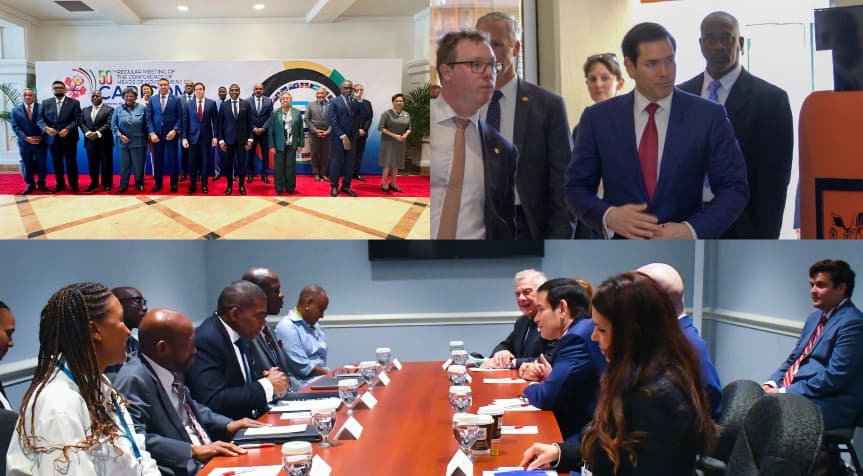
St Kitts and Nevis: History was made as United States Secretary Marco Rubio landed in St. Kitts and Nevis on February 24, 2026, for the 50th Regular Meeting of the Conference of Heads of Government of the Caribbean Community. The meeting was a pivotal moment after the US carried out a military strike in Venezuela and arrested Nicolás Maduro and his wife.
Rubio arrived in Basseterre as a specially invited guest to one of the region’s largest summit gatherings in years. The meeting was hosted under the chairmanship of Prime Minister Dr Terrance Drew and themed “Beyond Words: Action Today for a Thriving, Sustainable CARICOM” and received more than 200 delegates including the CARICOM heads of state, international partners and leaders of global institutions.
Being the first US Secretary to address the CARICOM leaders in roughly over a decade, Rubio expressed his satisfaction saying that the USA administration is once again giving priority to the Western Hemisphere after largely being ignored for a very long time.
Rubio on Venezuela: “Better Off Today Than Eight Weeks Ago”
The US Secretary used his address to directly confront regional concerns about the U.S. military operation that ousted Venezuelan President Nicolás Maduro earlier this year. Speaking to CARICOM leaders, Rubio acknowledged that some members may have reservations about U.S. actions, but he defended them emphatically:
Irrespective of how some of you may have individually felt about our operations and our policy toward Venezuela, I will tell you this, and I will tell you this without any apology or without any apprehension: Venezuela is better off today than it was eight weeks ago.
He argued that since the operation, Venezuela’s interim authorities had made what he called “substantial” progress, including releasing political prisoners and taking steps he described as previously “unimaginable.”
Rubio Calls Transnational Criminal Organizations As Most Urgent Security Threat
Marco Rubio’s visit to St. Kitts was brief but it was packed with symbolic and strategic engagements. In his address, he focused heavily on security.
He described transnational criminal organisations as ‘the most urgent security threat’ to both the Caribbean and the United States. He warned that illicit arms and drugs which are moving through the region undermine stability and prosperity.
The US Secretary further acknowledged that many of the weapons in circulation are sourced from the United States and pledged continued efforts by American law enforcement to disrupt these supply chains.
US Seeks To Work With Caribbean On Energy Issues
He further stressed the importance of economic collaboration, especially in energy and investment, and reaffirmed U.S. readiness to expand economic partnerships. Rubio said Washington views the region’s security and prosperity as deeply interconnected with its own which again signalled a renewed focus of the US on the Caribbean region.
“Energy is critical for the future; it’s critical for every economy in order to prosper. Many of the countries represented here today have energy resources that I know you seek to explore responsibly, safely, but in a way that generates wealth and prosperity for your people and your countries, and we want to be your partner in that regard,” he said.
Experts argue that the arrival of Marco Rubio into the United States symbolizes Washington’s renewed diplomatic focus on the Caribbean after years of relative disengagement. This, once again, reignites a relationship which many regional leaders saw as fading after the Trump administration stepped back from engagement in recent years.
What This Means for St. Kitts and Nevis and CARICOM
For St. Kitts and Nevis, hosting the US Secretary of State at the 50th Regular Meeting of Caribbean Community (CARICOM) elevated the country’s diplomatic profile far beyond its geographic size. The visit positioned Basseterre not merely as a host city, but as a strategic convening point for global dialogue. The summit also reinforced St Kitts and Nevis’ growing role as a bridge between global powers and small island states.
On February 25, PM Drew also held a high-level bilateral meeting with US Secretary Rubio. This meeting opened new paths for the two countries as focused on deepening cooperation between St. Kitts and Nevis and the United States. The engagement centred on expanding educational opportunities, strengthening energy security, enhancing infrastructure and technical training, and increasing collaboration in addressing transnational crime. The meeting also emphasized the Federation’s pursuit of economic transformation and the importance of building long-term capacity through partnerships with U.S. institutions, including expanded access to universities, and specialized training in areas such as structural engineering and data security.
“The United States remains an important partner, and I am committed to ensuring that our engagement delivers tangible benefits for the people of our Federation and the wider Caribbean region,” said PM Drew during the high level meeting.
Rubio further vowed deeper security as well as economic cooperation with Caribbean countries on Wednesday. He told regional leaders that Washington strives to ‘rebuild and construct a new dynamic’ in the Western Hemisphere.
The secretary also stressed economic partnership, especially in the energy sector. He noted that several Caribbean countries seek to responsibly develop their energy resources adding that, “Energy is critical for the future; it's critical for every economy in order to prosper.” He further encouraged expanded American investment in the Caribbean region.
Rubio’s Brief Visit Leaves CARICOM Leaders Optimistic
Caribbean leaders say they are encouraged following high-level talks with United States Secretary of State Marco Rubio on Wednesday, as Washington signalled a willingness to deepen engagement with the Caribbean Community (CARICOM).
Rubio also met with the CARICOM leaders in a joint US Caribbean closed-door meeting following the brief encounter. In addition, he also held bilateral talks with the leaders of Trinidad and Tobago, Guyana and Haiti.
The CARICOM leaders said they were encouraged by the statements made by the visiting senior Donald Trump administration official, with Antigua and Barbuda Prime Minister Gaston Browne saying, “Though he made a brief statement, he would describe it as very encouraging.”
“At one point we're very concerned precisely what the message would have been. But I have to say it's a very positive message in terms of helping to secure the future of Caribbean countries, to work closely with the various Caribbean countries and recognizing the fact that we are linked by geography, we are linked by our people,” said Browne.
He added that the Caribbean has its largest diaspora in the United States and they are also linked by common humanity and he sensed that the statement Marco Rubio made has signalled his commitment to enhance the relationship between the United States and CARICOM.
Dominica's Prime Minister, Roosevelt Skerrit, said he was also encouraged by the brief encounter the leaders had with Rubio and was looking forward to the further engagements. “We appreciate his visit and it is important that the dialogue can continue,” he added.
Trinidad and Tobago Prime Minister Kamla Persad-Bissessar, who held bilateral talks with Rubio, later told reporters that Port of Spain had been invited to a meeting of Latin American leaders to be held in Miami on March 7th. She said also that the meeting with Rubio was a follow up on some earlier discussions on cooperation in energy and security.
Author Profile

Monika Walker is a senior journalist specializing in regional and international politics, offering in-depth analysis on governance, diplomacy, and key global developments. With a degree in International Journalism, she is dedicated to amplifying underrepresented voices through factual reporting. She also covers world news across every genre, providing readers with balanced and timely insights that connect the Caribbean to global conversations.
Latest
- WATCH: Ne-Yo, Tabou Combo, Extasy Band and Full Blown perfor...
-
Trinidad: Wanted man killed in police-involved shooting duri... -
American Airlines flight returns to Miami after passenger al... -
St. Kitts and Nevis Broadcaster Saju Ng’alla dies -
WATCH: World Creole Music Festival 2026 opens with vibrant p...


