
Grenada will not wind down CBI Programme, PM Mitchell pushes back against EU pressure
Mitchell says the programme provides vital non-tax revenue for debt management, national development and economic resilience, and calls for financial support if a phase-out is required.
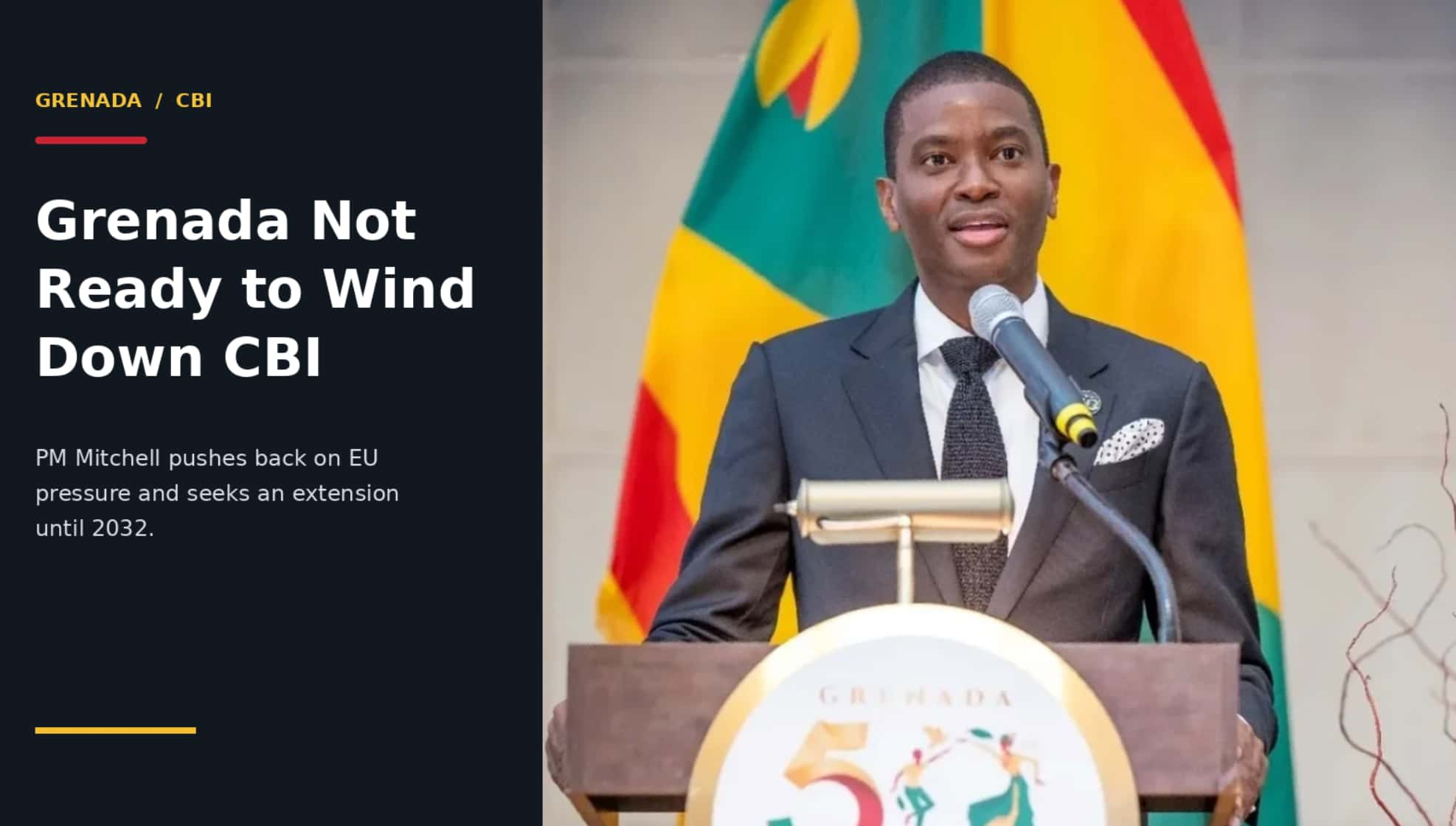
Grenada: Prime Minister Dickon Mitchell has confirmed that Grenada has no immediate plans to wind down its Citizenship by Investment (CBI) Programme, despite mounting pressure from the European Union (EU) on Caribbean nations to phase out their investment migration schemes or risk losing visa-free access to the Schengen Area.
While speaking during a one on one interview, he made it clear that Grenada is pursuing a different approach from Antigua and Barbuda which has expressed a willingness to terminate its programme subject to negotiations over transitional arrangements.
“No, we're not moving in the direction of winding up the CBI programme,” Mitchell stated.
The Prime Minister revealed that Grenada has formally requested an extension until 2032 rather than the June 2028 deadline sought by the European Union and cited the programme's critical contribution to government revenue, national development and economic resilience.
Notably, the European Union has increased scrutiny of citizenship-by-investment programmes operating in five Eastern Caribbean countries: Grenada, Dominica, Saint Lucia, St. Kitts and Nevis, and Antigua and Barbuda. Under the EU's revised visa suspension mechanism, the operation of an investor citizenship scheme can provide grounds for suspending visa-free travel privileges.
PM Mitchell explained that Caribbean governments have been working closely with the United States, United Kingdom and European Union to strengthen the integrity of their programmes through improved oversight, regulation and security measures.
These efforts include establishing a regional regulatory authority, introducing stronger compliance mechanisms and exploring the implementation of biometric screening with support from US authorities.
However, he expressed concern that the EU's latest position places the continued existence of CBI programmes at the centre of discussions, despite the reforms undertaken by participating countries.
Grenada has responded by requesting additional time to assess the implications of a potential phase-out.
“We've been asking for five years. We're asking until 2032,” Mitchell said, underscoring the need for a more realistic transition period.
While defending the programme, the Prime Minister highlighted the significant role that citizenship by investment revenues have played in strengthening Grenada's public finances.
He noted that income generated through the programme has provided an important source of non-tax revenue, supporting debt management, economic development and the country's ability to withstand external shocks.
He further recalled Grenada's previous debt restructuring arrangements, under which stronger investment migration revenues could trigger additional payments to bondholders.
According to Mitchell, the programme has helped Grenada reduce its debt burden while strengthening its capacity to respond to hurricanes, international conflicts, rising energy costs and other economic disruptions.
He emphasised, “These programmes have significant fiscal resilience for the country.”
PM Dickon Mitchell argued that small island developing states face economic vulnerabilities that are substantially different from those experienced by larger European economies which makes the sudden loss of a major revenue source particularly concerning.
The Prime Minister stressed that any eventual decision to discontinue the programme would require serious discussions with European partners about financial assistance and alternative sources of government revenue.
He questioned how Grenada and other Caribbean states would replace the substantial income currently generated through investment migration if they were expected to abandon their programmes to preserve visa-free travel.
“If we simply give this up to save a visa waiver agreement, then the obvious question is where are we going to get the revenue and the financial support from?” Mitchell asked.
He maintained that any transition away from CBI would need to be accompanied by a comprehensive development package designed to protect national finances and support economic stability.
Mitchell also called on the European Union to recognise the realities facing Caribbean economies, particularly their exposure to climate-related disasters, global geopolitical tensions and fluctuating fuel prices.
Author Profile

Monika Walker is a senior journalist specializing in regional and international politics, offering in-depth analysis on governance, diplomacy, and key global developments. With a degree in International Journalism, she is dedicated to amplifying underrepresented voices through factual reporting. She also covers world news across every genre, providing readers with balanced and timely insights that connect the Caribbean to global conversations.
Latest
- Grenada will not wind down CBI Programme, PM Mitchell pushes...
-
Six Jamaican artists earn Best Reggae Album nominations for... -
St. Croix to host 74th Crucian Christmas Festival with month... -
Caribbean Airlines confirms passenger booking data breach th... -
Marella Explorer 2 and MSC Poesia bring more than 3,950 pass...


