
Belize: LGBTQ+ advocates renew calls for equal protection after Privy Council ruling
Although Belize decriminalised consensual same-sex relations in 2016, advocates say the country still lacks comprehensive legal protections against discrimination in employment, education and public services.
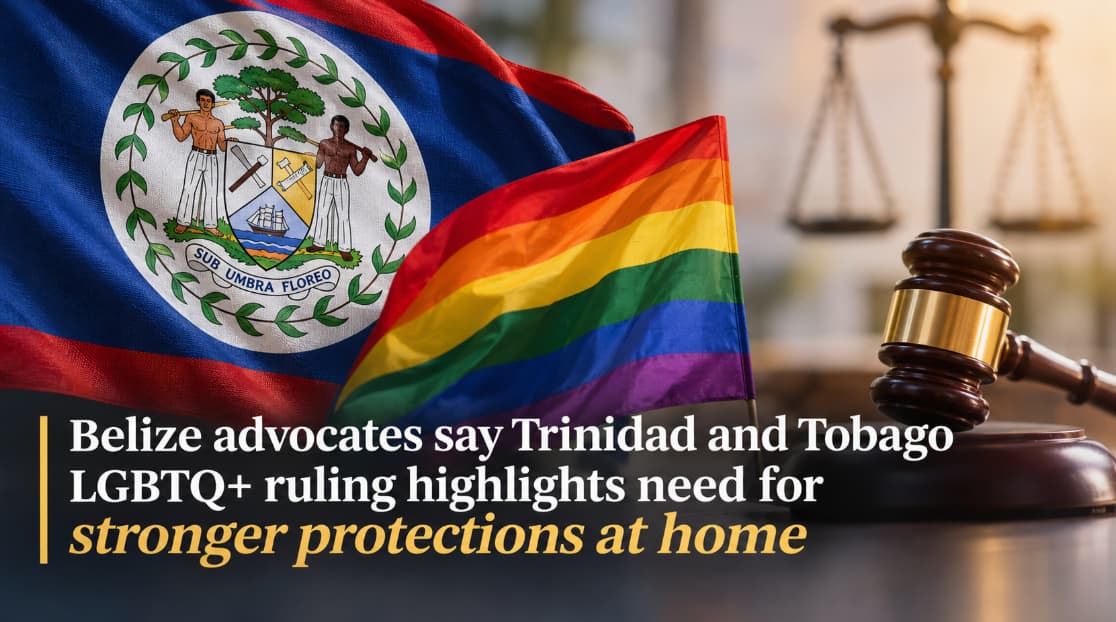
Belize: The ruling of the Privy Council on same-sex-related crimes in Trinidad and Tobago has brought attention to missing protections for the LGBTQ+ community in Belize, the Belizean advocates noted on November 18, 2026.
The Privy Council ruled on November 10, 2026 in favour of LGBTQ+ rights activist Jason Jones.
It noted that the provisions of Trinidad and Tobago’s Sexual Offences Act cannot be used to criminalise private, consensual sexual relations between adults of the same sex.
Jones has stated that the ruling is significant for other countries as well, in addition to those that utilise the Privy Council as their final court of appeal.
Belize is not one of them. Attorney Amanda Clift-Matthews said the ruling does not automatically bind every Caribbean country, noting that Belize falls under the Caribbean Court of Justice.
However, she noted that this ruling may encourage governments to remove similar legislation or may encourage legal challenges within local courts.
In 2016, consensual same-sex relationships were decriminalised in Belize, after Section 53 of the Criminal Code was read down by the Supreme Court. This decision was confirmed by the Court of Appeal in 2019.
Advocates say decriminalisation did not settle the question of equal treatment. The proposed Equal Opportunities Bill, which would protect against discrimination in areas such as employment, education and access to services, has not advanced through the legislative process.
It is currently being worked on following requests for additional consultation.
United Belize Advocacy Movement Executive Director Caleb Orozco said the Trinidad and Tobago ruling exposes a contradiction in Caribbean states that keep colonial-era laws while claiming to value independence and the fundamental rights of citizens.
He said that in order to move forward, Belize must provide further protection from discrimination. Without political direction, members of the public will continue to rely on the courts to demand equality, he added.
Author Profile

Monika Walker is a senior journalist specializing in regional and international politics, offering in-depth analysis on governance, diplomacy, and key global developments. With a degree in International Journalism, she is dedicated to amplifying underrepresented voices through factual reporting. She also covers world news across every genre, providing readers with balanced and timely insights that connect the Caribbean to global conversations.
Latest
- Belize: LGBTQ+ advocates renew calls for equal protection af...
-
Jamaica: Two injured in shooting at home in Clarendon -
American Airlines sets two-bag limit on flights to St. Kitts... -
PM Roosevelt Skerrit Announces December 16 General Election... -
Grenada will not wind down CBI Programme, PM Mitchell pushes...


