US Judge strikes down Trump’s visa ban affecting 75 countries
Judge Jeannette Vargas ruled that the policy unlawfully blocked immigrant visa applicants based on their nationality and ordered consular officers to review applications on a case-by-case basis.
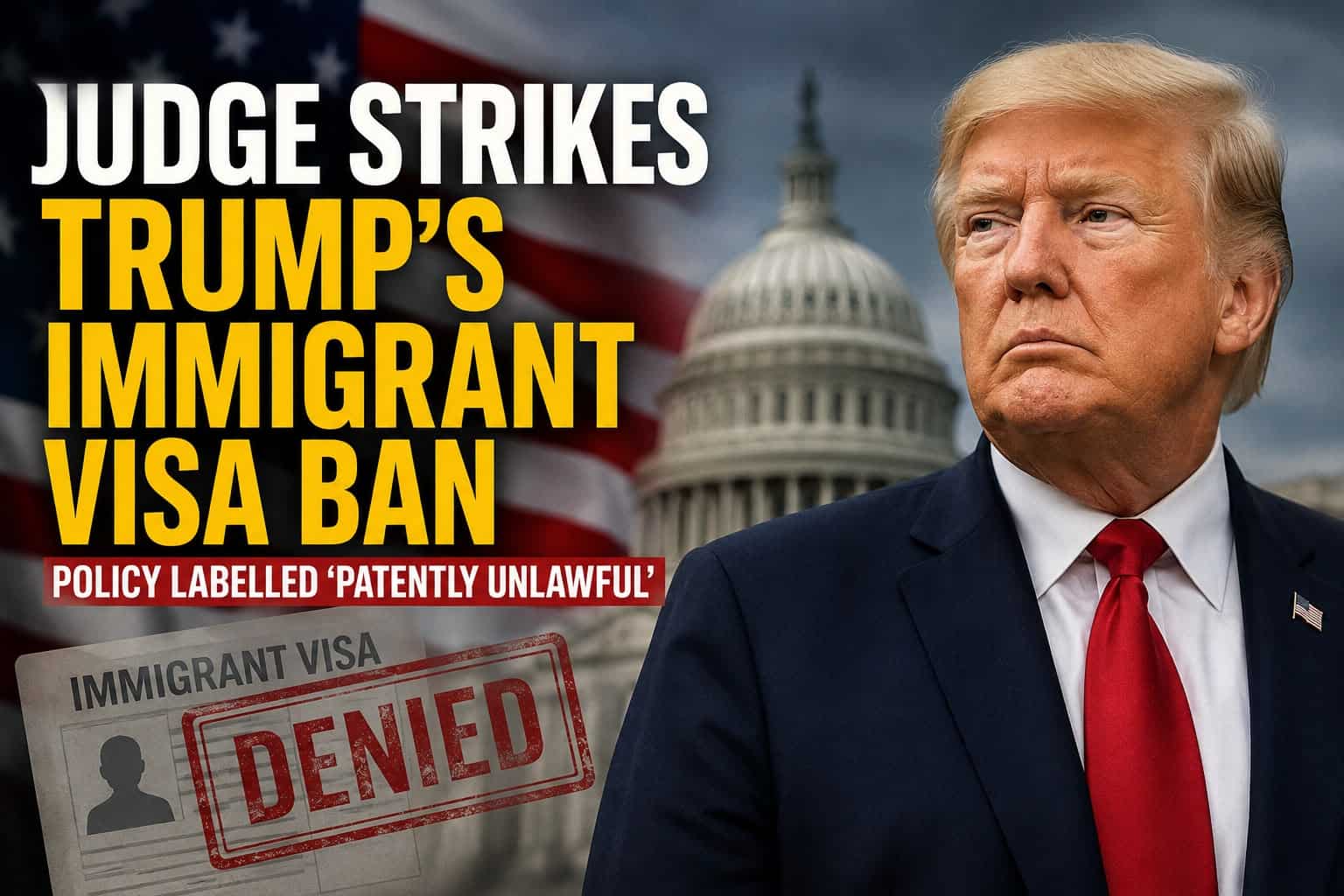
A federal Judge in Manhattan has struck down President Donald Trump’s decision to suspend immigrant visas to applicants from 75 countries. In a landmark ruling, Judge Jeannette Vargas labelled the policy as “patently unlawful”, saying that it also conflicted with federal immigration law.
Judge Vargas, an appointee of former President Joe Biden, issued the ruling after immigrant rights groups Catholic Legal Immigration Network and African Communities Together filed a lawsuit. The lawsuit also included multiple applicants for immigrant visas and US citizens sponsoring their family members from the suspended countries.
Earlier this year, when announcing the suspension, the US Department of State said applicants from these 75 countries were “at a high risk for becoming a public charge and a recourse to local public”.
The suspension also affected immigrant visa applicants from Antigua and Barbuda, the Bahamas, Barbados, Dominica, Grenada, Haiti, Jamaica, Saint Kitts and Nevis, Saint Lucia, and Saint Vincent and the Grenadines.
Prime Minister of Antigua and Barbuda lauded the recent judgment and shared a news piece on his official Facebook page.
Notably, restrictions on B1/B2 visas or bond requirements in some countries remain in place, as the recent judgment applies only to permanent residency visas that offer long-term stays and welfare benefits.
What was Trump’s immigrant visa ban?
The immigrant visa ban was an administrative policy introduced by President Donald J. Trump that banned the issuance of permanent residence visas to nationals of 75 countries. The policy was initiated on 21 January, 2026.
Implementation
As part of this comprehensive policy, consular officers were directed to reject applicants from these countries even if they could prove financial self-sufficiency.
State Department’s Take
During the announcement, the US Department of State had argued that the suspension prevented individuals from high-risk countries from taking advantage of the country’s welfare schemes or becoming a ‘public charge’ in the United States.
The Setback
Following the suspension, various immigrant-backed groups challenged the decision and filed a lawsuit in the US. District Court for the Southern District of New York. Judge Jeannette Vargas labelled the policy as “patently unlawful” on Friday 21 August, 2026.
Impact of the Judgement
The Judge also directed all the US Embassies and consulates to make their decision based on a fair, case-by-case review instead of denying visas solely based on an applicant’s nationality.
Author Profile

Monika Walker is a senior journalist specializing in regional and international politics, offering in-depth analysis on governance, diplomacy, and key global developments. With a degree in International Journalism, she is dedicated to amplifying underrepresented voices through factual reporting. She also covers world news across every genre, providing readers with balanced and timely insights that connect the Caribbean to global conversations.
Latest
- Guyana: 45-year-old man dies in house fire in Fyrish, Corent...
-
Trinidad: 47-year-old woman shot dead outside her home in Ar... -
Guyana: 20-year-old motorcyclist dies after collision on Eas... -
PM Drew returns to St. Kitts and Nevis after stroke recover,... -
WATCH: Ne-Yo, Tabou Combo, Extasy Band and Full Blown perfor...