
Antigua and Barbuda’s CIP remains open as EU phase-out talks continue, CIU confirms
The Citizenship by Investment Unit says it will remain operational until further instructions, while the government seeks a transition period extending to December 2030.
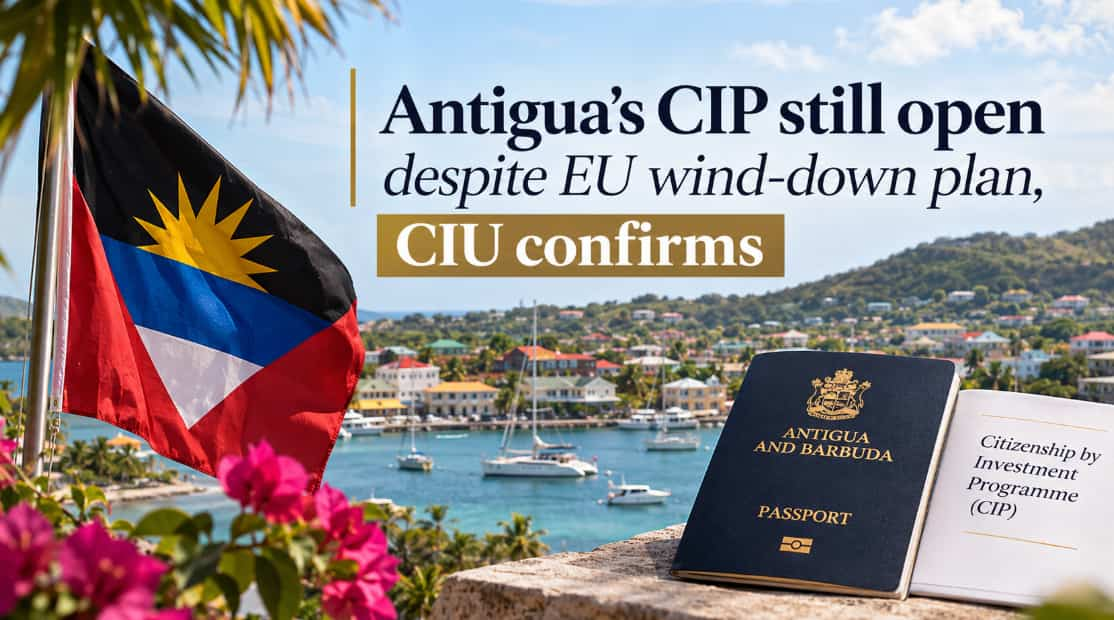
Antigua and Barbuda: Antigua and Barbuda’s Citizenship by Investment Programme (CIP) still remains open and is taking applications, despite the government informing the European Union (EU)that it intends to wind down the scheme.
The Citizenship by Investment Unit (CIU) confirmed through a memorandum to stakeholders on November 12, 2026 that the organization is still active and accepting applications.
CIU Chief Executive Officer Charmaine Donovan said, “The CIU remains operational and continues to accept applications for citizenship.”
The unit will remain active until instructed otherwise, as per the memo.
The memo came on the date Caribbean governments had been asked to communicate their positions to Brussels. It does not give any indication of when the programme will be closed or if the European Commission have agreed to the request for more time.
What Antigua and Barbuda has told Brussels
The government informed European Commissioner for Internal Affairs and Migration Magnus Brunner on October 30, 2026, that they intend to phase out the programme.
They requested a transition period up until the end of 2030. This comes after a letter dated June 25, 2026, from the commission requesting a phasing out by June 1, 2028. The government’s proposed date is about two years and seven months later.
The government has also asked for EU technical expertise and financial support. It plans to submit an assessment of the economic, financial, social and legal impact of ending the programme to the Commission by March 2027, as WIC News reported on November 2, 2026.
The memo says the EU hosted heads of citizenship units in March 2026 and told participating countries they would need to say whether they intended to continue their programmes.
Technical delegations met with EU representatives on October 20, 2026 with the assistance of the Eastern Caribbean Central Bank and Organisation of Eastern Caribbean States. Nations agreed to give their final decision by November 12.
There is no mention of what will happen to applications currently being processed or approved investments and existing contracts once the programme is closed.
A response date, not a closure date
Prime Minister Gaston Browne said on October 31, 2026 that November 12 was a deadline for responding to the EU and not the date the programme would shut.
He had said on October 24 that preliminary Cabinet discussions leaned towards suspension, but that no final decision had been made.
He has warned that if the programme closes without proper preparation it could cause issues with public finances and development projects. If no deal can be reached, the EU could impose visa restrictions as early as January 2027, taking effect around March to April.
EU security concerns and what is at stake for visa-free travel
The European Union has raised concerns about citizenship by investment programmes and their implications for security and visa-free access to Europe’s Schengen area.
For Antigua and Barbuda it is a difficult negotiation between preserving an important revenue source and protecting visa-free travel privileges for citizens.
The memorandum provides assurance to investors, authorised agents and other stakeholders that the CIU operates in the same way.
Author Profile

Monika Walker is a senior journalist specializing in regional and international politics, offering in-depth analysis on governance, diplomacy, and key global developments. With a degree in International Journalism, she is dedicated to amplifying underrepresented voices through factual reporting. She also covers world news across every genre, providing readers with balanced and timely insights that connect the Caribbean to global conversations.
Latest
- Antigua and Barbuda’s CIP remains open as EU phase-out talks...
-
Dominica Cable Car Project announces up to 300 job vacancies... -
Guyana: Police probe one-year-old’s death at Georgetown dayc... -
Dominica: PM Roosevelt Skerrit mourns death of mother-in-law... -
PM Browne urges stronger South-South Climate Cooperation, re...


