
Jamaica: School health survey raises concerns over worsening student mental health
Jamaica’s 2026 GSHS surveyed 3,058 students across 32 high schools, highlighting concerns over self-harm risk, parental engagement, diet and declining physical activity.
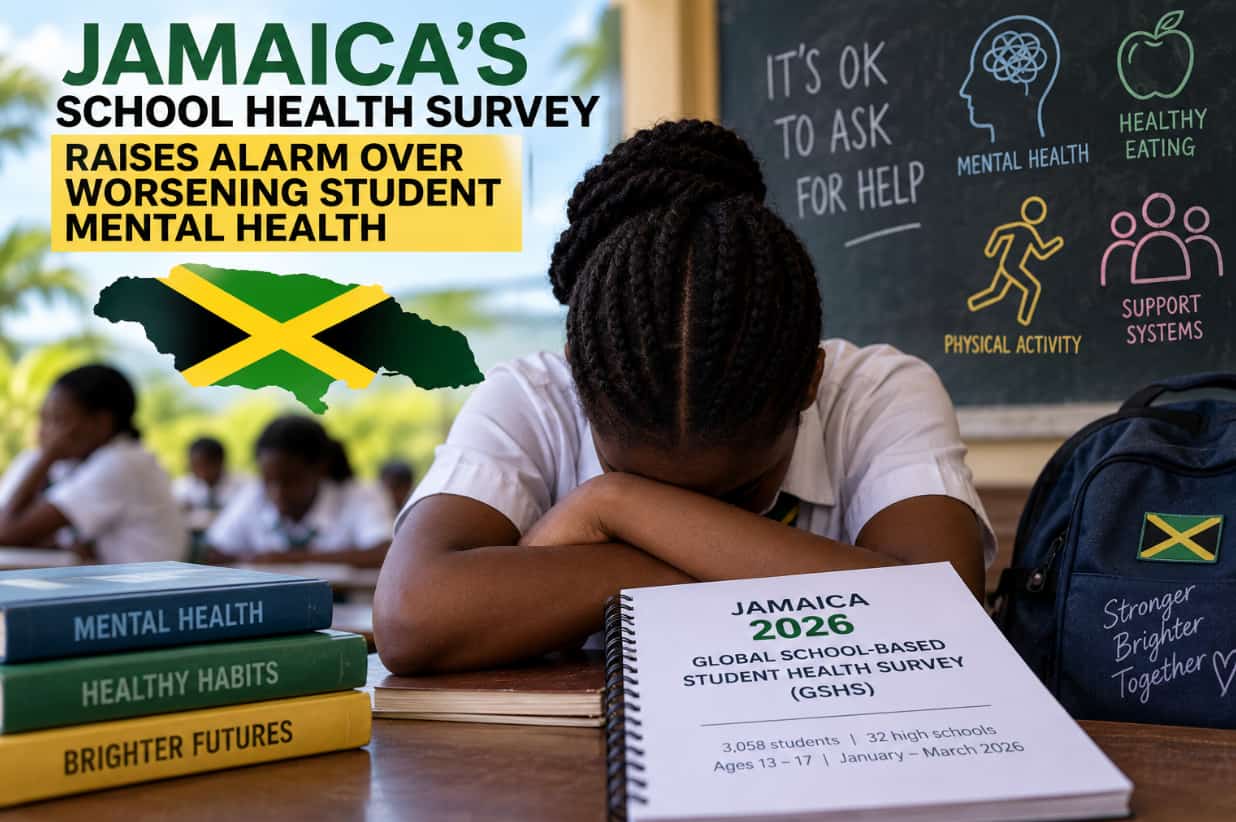
Jamaica: A national health survey has revealed several cases of worsening mental health indicators among Jamaican secondary school students, including rising self-harm risk, along with poor dietary habits and declining physical activity.
The results come from Jamaica's 2026 Global School-Based Student Health Survey (GSHS). The survey was conducted among 3,058 students aged between 13 to 17 across 32 high schools between the months of January and March 2026.
The survey evaluated nine key areas, including, substance use, diet, social media use, sexual behaviour, and tracking student behaviour over the previous year.
The survey revealed that there is a rural high school in Jamaica in which almost every student in the seventh-grade class is allegedly receiving counselling for self-harm.
Additionally, a study by the National Council on Drug Abuse (NCDA) revealed that one student reported that she has tried taking her life so many times that she can’t even recall the exact number of times she has done that.
Uki Atkinson, acting principal director of the Public Education and Treatment Branch of NCDA said, "At first, we assumed she didn’t understand the question. But she explained that she did, and repeated that she could not count the number of times she had attempted it.”
After Atkinson completed the survey, she went to the guidance counsellor who disclosed that almost all of the students of that class are being monitored by the school and other professionals, as some students were reportedly already engaging in such practices.
She also noted that as compared to the survey in the year 2017, the mental health state of our adolescents is declining.
Four in ten students said their parents knew their whereabouts and activities during free time, and a similar proportion said their parents spent quality time with them.
Jacqueline Bryan, a veteran guidance counsellor and former president of the Jamaica Association of Social Workers said the decline in student mental health may trace back to the COVID-19 pandemic, when many students were at home and exposed to unsupervised social media content.
Furthermore, the survey also pointed to a broader decline in parental coping skills as a contributing factor.
Author Profile
Sasha Baptiste reports on local Caribbean news with a strong focus on crime, justice, community issues, and entertainment. With a background in sociology and journalism, she brings a grounded, people-centered perspective to her reporting, shedding light on the challenges and resilience within Caribbean societies.
Latest
- Bahamas issues severe weather warning to New Providence
-
Caribbean Airlines adds flights as Tobago gears up for Carni... -
Colombian Pastor dies after alleged gang beating in Cartagen... -
Trinidad and Tobago: 19-year-old found dead from gunshot wou... -
Dominica: Samantha Bazil of Wesley wins Crowned Miss Wob Dwi...