
Minimum wage increase necessary to life workers and maintain economic balance: PM Skerrit
The board conducted a thorough review over several months, considering submissions from both private sector representative bodies and individual employers.
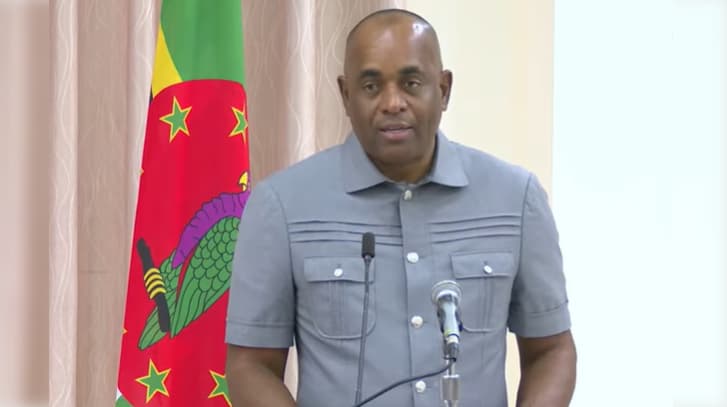
Dominica: Prime Minister Dr Roosevelt Skerrit has defended the government’s decision to increase the national minimum wage and described the move as necessary step to improve the livelihoods of low-income workers while safeguarding economic stability and protecting businesses from undue pressure. He made this statement during his End of Year Conference which took place on Monday.
He noted that following the implementation of the new minimum wage on December 1, 2025, the government received feedback and concerns from private sector leaders and added that all of these were carefully considered.
“The government established the minimum wage advisory board precisely to ensure that all sectors had an opportunity to contribute to the process,” PM Skerrit said.
According to the Prime Minister, the board conducted a comprehensive review over several months and considered submissions from private sector representative bodies as well as individual employers. While not all recommendations were reflected in the final wage schedule, he said the board was required to balance business concerns with the overriding objective of ensuring a fair and livable wage for workers, particularly those at the lowest end of the income scale.
He further acknowledged that the implementation date needed adjustments for some employers but said the government had to weigh those concerns against the urgent need to address wage stagnation and rising cost of living.
“Many private sector employees have not seen real wage growth in over a decade, even as the economy has recovered and certain sectors have posted strong performance,” he stated.
The Dominican leader emphasised that the Ministry of Labour will continue reviewing transition challenges raised by employers and will assess whether practical administrative support or reasonable phased arrangements may be appropriate in specific areas.
He stressed that the government’s objective extends beyond wage increases. “Government’s objective is not merely to raise wages but to raise standards, to encourage decent work, and to support a sustainable, competitive and vibrant private sector,” the Prime Minister said.
He further addressed concerns that the wage increase could fuel inflation and dismissed what he described as common misconceptions. “Contrary to common misconception, increasing the minimum wage does not automatically lead to higher inflation. What matters is how the adjustment is managed,” Dr Skerrit stressed.
While citing an example, he explained that in most retail businesses across the Caribbean, wages account for only 10 to 15 percent of the final prices of goods. Using a $200 grocery bill as an example, Skerrit said labour typically accounts for about $30 while the remaining $170 reflects landed costs, duties, taxes, overheads and profit.
“A 30 percent increase in the minimum wage means that the $30 labour share would increase by $9,” he explained. “Contrary to the alarm that a 30 percent increase in the minimum wage will trigger a $60 increase on a $200 grocery bill, the actual increase would be $9 or 4.5 percent.”
He added that retail prices are driven primarily by international freight costs, global commodity prices, exchange rate shifts and import duties and not local labour costs. “A higher minimum wage does not affect these cost drivers,” Skerrit said.
In his address, the Prime Minister also gave regional examples and noted that Caribbean nations such as Barbados, Jamaica, Antigua and Barbuda, and Saint Lucia increased minimum wages in the past decade without experiencing significant retail inflation linked to wage hikes.
Prime Minister Roosevelt Skerrit outlined several government measures which included productivity support through skills training, digitisation and process improvements, reducing operating costs for businesses through targeted relief and efficiency measures, targeted support for vulnerable and labour-intensive sectors, and strengthened oversight to prevent price gouging in order to ensure a smooth transition.
“Government is closely monitoring the market to prevent unfair price increases,” he said and added that competition and regulatory oversight would ensure that any cost adjustments remain fair and justified.
The Prime Minister also added that the minimum wage increase was widely welcomed even by employers who acknowledged that many workers were already earning above the previous minimum.
“The law now had to be changed to make it mandatory that people receive a fair wage for a fair day’s work,” he said. He added that the timing of the increase was deliberate, saying that he is happy that his administration was able to do so in time for Christmas.
Author Profile

Monika Walker is a senior journalist specializing in regional and international politics, offering in-depth analysis on governance, diplomacy, and key global developments. With a degree in International Journalism, she is dedicated to amplifying underrepresented voices through factual reporting. She also covers world news across every genre, providing readers with balanced and timely insights that connect the Caribbean to global conversations.
Latest
- Bahamas Police seize high-powered firearm and marijuana; Fiv...
-
Guyana: Opposition Leader Azruddin Mohamed alleges sexual as... -
Bahamas warns of Gale-Force winds and dangerous seas as stro... -
Trinidadian man faces possible Guyana travel ban after alleg... -
Jamaica charges 19-year-old in triple murder and arson attac...