
St. Kitts-Nevis Labour Party marks 4 years with major gains in water, healthcare, infrastructure
The government highlighted progress in water security, electricity, healthcare, education and public infrastructure as it marked four years in office and reaffirmed plans to continue major development projects.
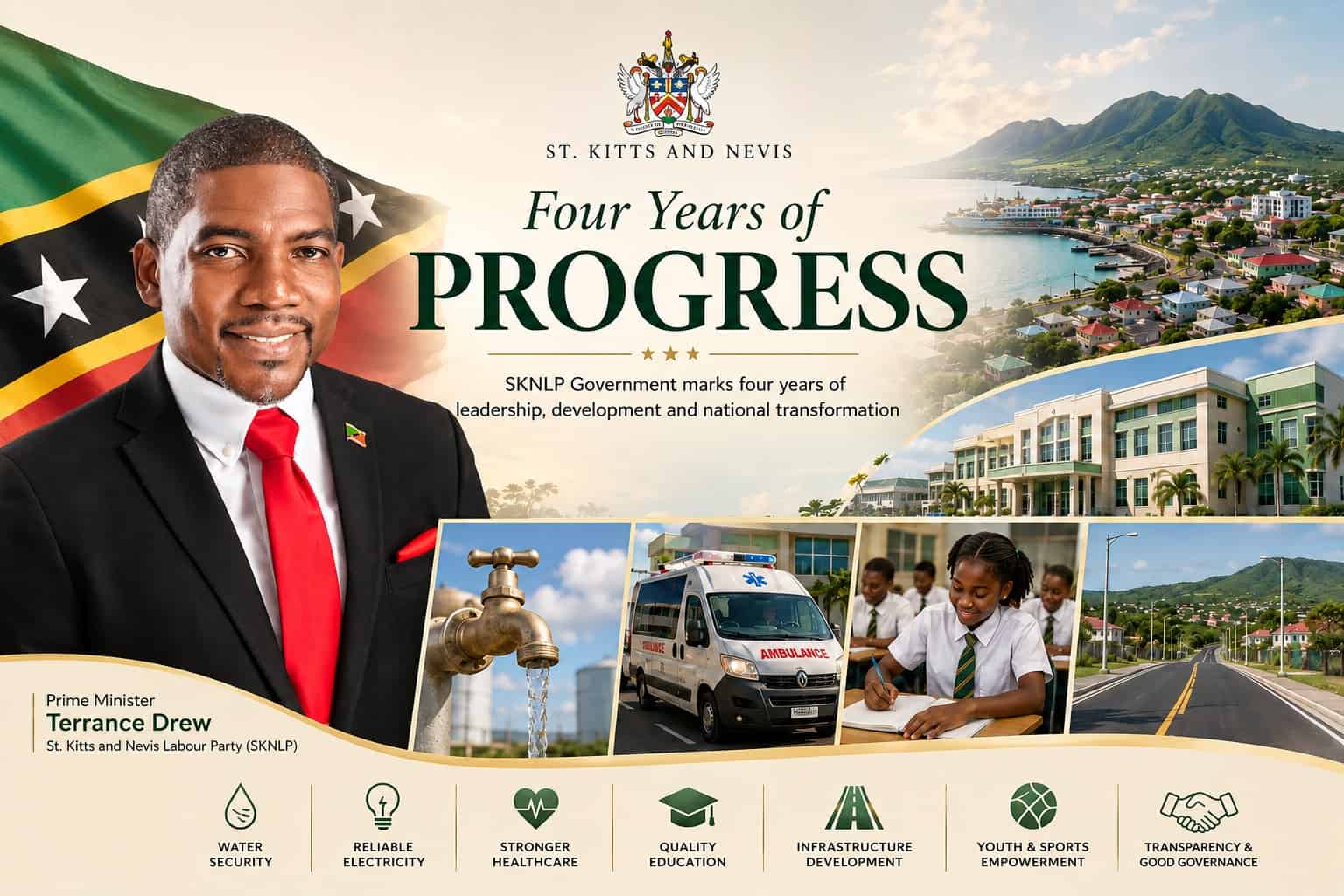
St. Kitts and Nevis: The government of St Kitts and Nevis marked four years in office on Wednesday, August 5, 2026. The St. Kitts and Nevis Labour Party administration took office after winning the election on August 5, 2022, by securing six of eleven seats in parliament to end the previous coalition government’s term.
Prime Minister Terrance Drew has earlier highlighted the state of the country when his government took office and the initiatives undertaken since then through a wide-ranging presentation to the National Assembly on 30 July 2026
As per that, the administration has expanded 24-hour water access from 24 percent to nearly 70 percent of the population as Drew noted that the drilling operations are continuing in other parts of St Kitts as the government works towards its goal of universal 24-hour water coverage, adding that the gains have come despite severe drought conditions and the growing effects of climate change.
In these four years the Federation of St. Kitts and Nevis has experienced significant advances in electricity generation, healthcare and education, as the administration remains focused on strengthening the national electricity system, modernising healthcare, and completing key education projects.
A new 500,000-gallon storage tank has also been completed as the work is continuing to connect the well to the tank. The increased production and storage capacity in Cayon will allow other water resources to be redirected to St. Peter’s, and will strengthen the reliability of the supply in that community.
The Government has also taken significant steps to address deficiencies in electricity generation and strengthen the reliability of the national grid.
The Government has also achieved significant growth in Healthcare with an expanded ambulance fleet, moving beyond the acquisition of a single replacement vehicle to strengthen the national emergency medical services as compared to four years ago when the Government inherited serious challenges at the Joseph N. France General Hospital, including sections of the facility that were affected by leaks during periods of rainfall.
The new Basseterre High School is one of the Government's most significant infrastructure projects, as the students and teachers waited for years for the promised institution.
Along with that, the Government's broader infrastructure programme also includes construction of the St. Peter's Main Road, valued at more than EC$30 million.
The Government is also working for the improvements to sporting facilities in Conaree and rehabilitation work at the Kim Collins Athletic Stadium.
While presenting to the National Assembly, Drew pointed to the passage and implementation of the Integrity in Public Life legislation, which requires public officials to declare their financial affairs and provides a mechanism for scrutinising any unexplained accumulation of wealth. He said the requirement applies to all officials, including himself.
Furthermore, reflecting on the collapse of the previous coalition government, Drew said the episode underscored the importance of political arrangements built on shared principles and trust.
He said politicians must be kept in check and that officials entrusted with public office should be held accountable for their conduct and decisions.
The Citizenship by Investment Programme has also featured prominently in the government’s record over the period, with the Federation’s programme named Programme of the Year at the Caribbean Investment Summit in Saint Lucia in May 2026, alongside three further awards recognising its efficiency, sustainability and regional influence.
Now the administration remains focused on achieving the 100 percent 24-hour water coverage, strengthening the national electricity system, modernising healthcare, completing key educational projects and achieving measurable improvements in the lifestyle of the people of the nation.
Author Profile

Monika Walker is a senior journalist specializing in regional and international politics, offering in-depth analysis on governance, diplomacy, and key global developments. With a degree in International Journalism, she is dedicated to amplifying underrepresented voices through factual reporting. She also covers world news across every genre, providing readers with balanced and timely insights that connect the Caribbean to global conversations.
Latest
- “Ready to serve”: PM Drew cleared to resume duties, heads to...
-
Guyana: Azruddin Mohamed in custody after gunfire outside Po... -
Trinidad: Mother calls for police action after videos of mis... -
Grenadian Violinist Jelani Moses to attempt Guinness World R... -
Trinidad and Tobago unveils TT$63.4B 2027 budget, targets lo...


