
Trinidad: Privy Council rules against criminalisation of consensual same-sex relations
The ruling follows a legal challenge by Jason Jones, who argued that provisions of the Sexual Offences Act violated his constitutional rights, including the right to private and family life.
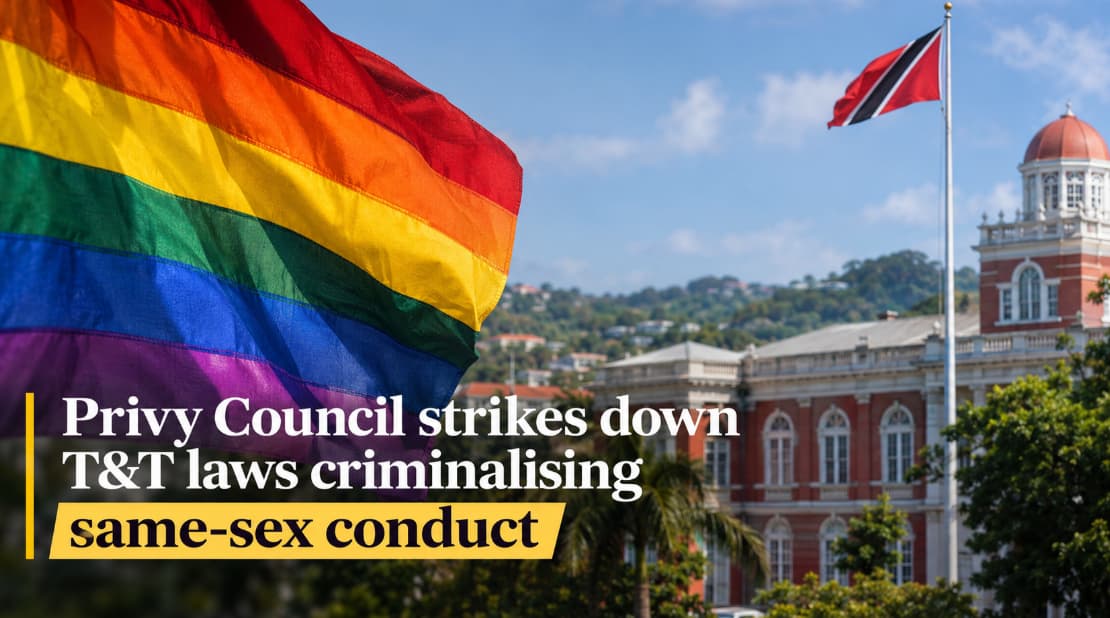
Trinidad and Tobago: The laws in Trinidad and Tobago that criminalise consensual same-sex acts have been overturned by the UK Judicial Committee of the Privy Council on November 10, 2026.
Judge Philip Sales stated that the laws seeking to criminalise such activities cannot be justified. The Court decided that the laws were incompatible with the basic human right to respect private and family life.
The case was brought by 62-year-old Jason Jones, who is a dual national of Trinidad and Tobago and the UK. The case has ended an 11-year long battle. He noted that he hopes this will help accelerate the fight for full equality.
These provisions stem from an act passed in 1925 during British rule. The act was included in the 1986 Sexual Offences Act. Buggery carries a maximum sentence of five years in prison, while gross indecency carries a sentence of two years.
Jones won his case in the High Court in 2018, however, in March 2025 the Court of Appeal partially overturned the ruling so Jones appealed to London. Five judges on the Privy Council heard the case on July 8, 2026.
The Attorney General defended the law, joined by the T&T Council of Evangelical Churches and the Sanatan Dharma Maha Sabha as interested parties.
The core issue was the savings law clause, which prevents certain laws that pre-date independence from being challenged on constitutional grounds.
Prime Minister Kamla Persad-Bissessar previously said she believed the ruling would be “very profound,” and would not only affect the sodomy laws but also the savings clause.
The ruling has drawn reactions from the residents as a user commented, “The Bible is clear that it is wrong, and our country should not allow it to continue openly. If the law is put in place, it will stop this sin from spreading in our nation and protect our children and our families. Trinidad and Tobago is a Christian nation and we should stand on what God says and not be afraid to enforce it.”
Another user commented, “Good to see the ruling finally in favour of the LGBT community, we people suffer a lot because of the criminalising law and discrimination we face.”
These laws have long led to stigmatisation, discrimination and violence against the LGBTQIA+ community. Even though they are rarely enforced, St. Kitts and Nevis has also decriminalised consensual same-sex relationships recently.
Author Profile

Monika Walker is a senior journalist specializing in regional and international politics, offering in-depth analysis on governance, diplomacy, and key global developments. With a degree in International Journalism, she is dedicated to amplifying underrepresented voices through factual reporting. She also covers world news across every genre, providing readers with balanced and timely insights that connect the Caribbean to global conversations.
Latest
- Trinidad: Privy Council rules against criminalisation of con...
-
Trinidad: 55-year-old man injured after pet Cane Corso attac... -
Dominica mourns 16-year-old Sprinter Keyoni Esprit after dro... -
Belize: Police investigate Shiloh Coleman’s murder after bod... -
Dominica: Parliament approves EC$248.5M supplementary estima...